
Project
STEP CHANGE: Demonstration of the Potential of Renewable Energy for Productive Use in Rural Uganda
ActiveImportedLed from Africa
Overall objective of the research: Demonstration of potential of off-grid renewable energy (RE) for productive use for agriculture in rural Uganda Objective 1: To identify the impacts achieved by three ongoing projects in Kyankwanzi, Kiboga and Luwero districts where agricultural cooperatives have been trained and mobilized to use renewable energy technologies Objective 2: To provide evidence on the potential of up-scaling of these technology transfer experiences to the whole region and provide an estimate of the up-scaling potential at national level.
About the project
Off-Grid Renewable Energy in Agriculture
Action for Rural Women’s Empowerment (ARUWE) together with Caritas Kasanaensis Luwero and Ndejje University is conducting research on Off-Grid Renewable Energy in Agriculture. The research aims at demonstrating the Potential of Renewable Energy for Production Use in Rural Uganda. Renewable energy in agricultural production can be a useful way of responding to the increasing energy demand of the sector as well as a means for promoting social and environmental sustainability. STEP CHANGE will develop knowledge about the impact of renewable energy technology for productive use in rural Uganda via a citizen science approach. Citizen scientists selected from farmers of six agricultural cooperatives and interested community members, will participate in the initiative.
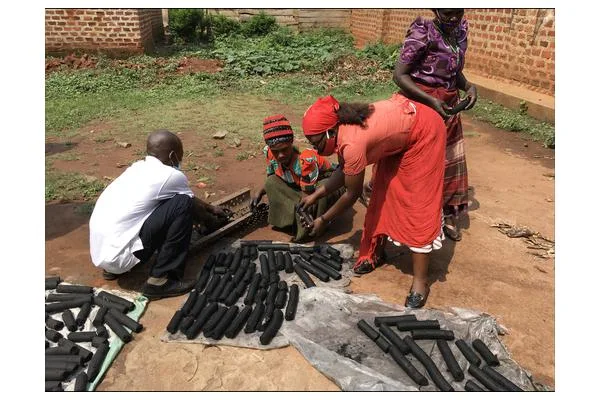
In Kyankwanzi, Kiboga and Luwero districts, agricultural cooperatives have been trained and mobilised to use renewable energy technologies. Their impact, notably when it comes to environment, individual and community autonomy, fighting corruption, knowledge transfer, and improved skills for economic benefit, will be investigated. Based on this analysis, it will be explored to what extent the adoption of renewable energy in agricultural production can be a useful way of responding to the increasing energy demand of the sector as well as a vehicle to promote social and environmental sustainability.
Building on lessons learnt, the Citizen Science Initiative will collect evidence on the potential of up-scaling of these experiences to the whole region while providing an esteem of the up-scaling potential at the national level.
This initiative is part of the Step Change project, which aims to explore how Citizen Science can make science more socially robust, inclusive and democratic. The project, launched in March 2021 and funded under the H2020 programme, will implement 5 Citizen Science Initiatives in the fields of Health, Energy and Environment”.
Citizen-science aspects
The study will target members of agricultural cooperatives in Kyankwanzi, Kiboga and Luwero districts that have been trained and mobilized to use renewable energy technologies in their agricultural practices. It will be a Comparative research involving and engaging two categories of respondents within the 3 target districts; i) Farming groups where the interventions have not been introduced (to be used as a control groups); ii) farming groups where the interventions have been introduced (to be used as experimental groups). The two categories of respondents will be compared in respect to; Knowledge, practices, values and attitudes related to use of RE technologies in farming and agricultural outputs and other tangible benefits attained by the two different categories.
Citizen scientists will be actively involved throughout the research in data interactively. Participants will be allowed to reveal their own understanding of the issues in the study. During data collection, the discussion will be kept both structured and unstructured to allow participants make free responses that are not confined within a list of possibilities.
Streamlined procedures will be followed to safeguard interests of the human subjects involved in the study i.e. ensuring confidentiality and Informed consent: Citizen Scientists who participate in research will give informed consent. ARUWE will disclose details of the study to allow participants to be informed of the overall purpose of the study and its main features, as well as the expected risks if any. Feedback with the participants during feedback meetings at different levels. With citizen scientists, the research findings and recommendations will be published and shared.
Equipment needed
Phones and Laptops
Details
- Lead organisation
- Action for Rural Women‘s Empowerment (Uganda)
- Where
- Regional or provincial
Uganda
Agricultural Cooperatives in Communities - Topics
- Agriculture and food, Climate and weather
- What volunteers do
- Classifying or identifying, Analysing data, Designing the project or solutions, Observing and recording, Other, Taking photos or recordings, Transcribing or annotating
- Dates
- Started March 1, 2021 · Ended December 31, 2023