
Citizen-science projects
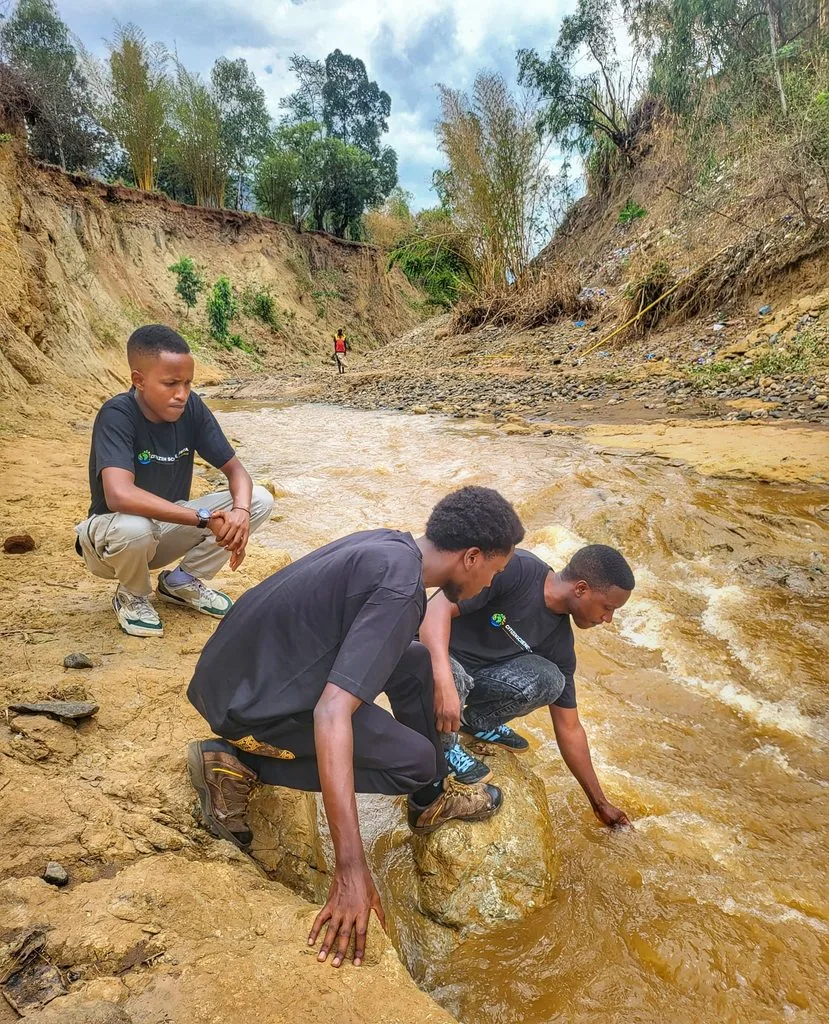
Lake Tanganyika community observatory
A water-monitoring programme that trains community participants and students to make repeated observations of water conditions along the Burundian shoreline of Lake Tanganyika, with scientific partners supporting method design, validation and interpretation
Question
How do water conditions along the shoreline change over time, and which parameters can be observed reliably by trained participants?
Participants
Lakeshore community members, fishers, students, teachers, local organisations, university students and researchers
Method concept
Shared protocols and accessible instruments for transparency, turbidity, nutrients (FreshWater Watch), visible pollution and shoreline condition, with parameters chosen alongside scientific partners
Evidence
Community feedback, research datasets, lake management conversations, environmental institutions and open data where appropriate
Partners
Scientific partners, lakeshore communities, schools, methods reviewers, local coordination
Status
Methods review, training, and sampling
External reference
Citizen-science water monitoring has been tested and published on the Tanzanian side of the same lake by other institutions.
School environmental observatories
A network model in which a school adopts a nearby environmental question and becomes a recurring observation site
Question
What can be learned when the same stream, wetland, shoreline or rainfall point is observed by students across a school year?
Participants
Teachers, students, school environmental clubs, parents and community audiences
Method concept
Teacher and student training, a repeatable protocol, observations on a regular cycle, submission on paper or digitally, supported analysis, community presentation
Evidence
School and community presentations, teaching materials, and research datasets where quality permits
Partners
Schools, teachers, education authorities, curriculum advisors
Status
Recruitment of participating schools
Freshwater Africa (FreWA)
An open platform that gathers what is already known about freshwater monitoring across Africa, and gives communities, schools and researchers a place to add new observations
Question
What do we already know about the condition of Africa’s rivers, lakes and wetlands, where are the gaps, and what can repeated local observation add?
Participants
Community members, schools, local organisations, universities, researchers, monitoring agencies and anyone with publicly available data on freshwater in Africa
Method concept
A shared catalogue and map of existing freshwater monitoring, plus a simple way for trained groups to add new observations using common protocols and data standards, so that every record shows where, when and how it was collected
Evidence
Openly accessible datasets, documented methods, data quality notes, and a map of monitoring sites and gaps across the continent
Partners
Monitoring programmes, universities, schools, community groups, open-data specialists, local coordinators
Status
Concept and design, starting with Burundi and Lake Tanganyika
Explorations
Earlier ideas, kept in the open
Exploration
Bujumbura flood + Watershed watch
An exploration of participatory observation around urban drainage, stream levels, rainfall impacts, erosion and recurring flood points
Question
Which problems recur, and what does repeated community observation add to existing engineering and resilience studies?
Participants
Neighbourhood organisations, residents, students, technicians
Exploration
Tanganyika Speaks
A citizen science and mixed-media art project on water quality of Lake Tanganyika in Bujumbura, Burundi
Concept
Tanganyika Speaks is a participatory art and citizen science project rooted on the shores of Lake Tanganyika in Bujumbura, Burundi. A local mixed-media artist and a citizen science specialist collaborate with lakeshore communities to monitor water quality at eight stations along Bujumbura’s polluted northern shoreline, and to transform that scientific process into a large-format sculptural installation. What makes this project unusual is the material continuity between scientific act and artistic output: the sediment, plastic debris, seashells, and water samples collected by community monitors (citizen scientists) become the literal building blocks of the artwork. Sand panels, plaster relief casts, gold-leafed recovered plastic, and fabric layers dyed with pigments derived from water samples create a growing archive of what the lake is saying, across three months, eight locations, and the hands of fifteen community monitors. The installation makes invisible environmental data visible, tactile, and politically legible to the people of Bujumbura, and ultimately to audiences everywhere.
Participants
Ange Shalome Mugisha is a Burundian visual artist based in Bujumbura whose practice centres on texture, materiality, and sculptural expression. Working across plaster relief, mixed media, fabric and folding art, sand and seashell compositions, gold leaf and metallic effects, and large-format statement pieces, her work brings abstract ideas to life through the materials’ physical properties. Each piece is constructed differently depending on the concept, emotion, and atmosphere she wants to convey, an approach that makes her practice uniquely suited to translating environmental data into sensory experience. Her work has been exhibited at multidisciplinary community exhibitions organised by the CLM church in Bujumbura, Burundi.
Citizen science and environmental monitoring specialists will support the project. With experience coordinating EU Horizon Europe projects, including ProBleu, a Horizon Europe water conservation and citizen science initiative, they bring expertise in participatory research methodology, community monitor training, data quality protocols, and EU project management. They have worked across Europe and Africa and have deep familiarity with both the scientific and community-engagement dimensions of environmental monitoring. They will design and lead the citizen-science component of Tanganyika Speaks and are responsible for project coordination and reporting.
Exploration
Burundi biodiversity observatory
An exploration of species and habitat observation at wetlands, protected-area edges and school sites
Question
What can repeated local observation contribute to understanding seasonal ecological change and habitat condition?
Participants
Students, community members, naturalists, university researchers, protected-area staff